

In Islam, marriage is far more than a social arrangement. The Quran describes the bond between husband and wife as a source of tranquillity, affection and mercy, meant to anchor both individuals spiritually and emotionally. Known as Nikah, this union is considered an act of worship built on mutual consent, respect and shared responsibility, so central to faith that the Prophet Muhammad described marriage as completing half of one’s religion.
Islam is practised across diverse cultures, so no two Muslim weddings look quite alike. A ceremony held in Karachi carries different colours, rituals and rhythms compared to one celebrated in Cairo, Jakarta or Sydney, yet beneath these surface differences sits a shared religious framework.
Four essentials hold it together: the Nikah contract, the presence of witnesses, mutual consent, and the specification of Mahr. Everything beyond this core, from bridal henna to elaborate feasting, stems from local custom rather than religious requirement, which explains why Muslim weddings feel universal in spirit yet so varied in expression, each one shaped by the traditions of the community celebrating it.
What Is a Muslim Wedding?
A Muslim wedding centres on the Nikah, the formal marriage contract joining a man and woman under Islamic law. It is a binding marriage contract under Islamic law with clear terms, willing consent from both parties and the presence of witnesses. Marriage holds a central place in Islamic teaching, seen as a means of fulfilling emotional, spiritual and social needs, and often described as a shared journey of faith and daily life between partners.
Every Muslim wedding carries two layers. The religious layer, rooted in the Quran and the Prophet Muhammad’s practices, governs the essentials: the contract, consent, Mahr and witnesses. The cultural layer, shaped by geography and family tradition, shapes everything else, from clothing and food to the sequence of celebrations. A Gulf wedding might favour a Zaffe procession, while a South Asian one follows Mehndi, Baraat and Walima. Together, these layers give each wedding its own character while honouring the same commitment.
What Happens Before a Muslim Wedding?
Marriage Proposal and Family Involvement
Families often play an active role in the proposal, guiding introductions and weighing compatibility across values and lifestyles. The final decision, however, rests on the willing consent of both the man and woman.
Engagement Traditions
A formal engagement ceremony often follows, marking the couple’s intent to marry through an exchange of gifts, rings and blessings from elders. The tone stays warm and modest rather than grand.
Pre-Wedding Celebrations
Many communities host a Mehndi or Henna ceremony in the days before the wedding, with intricate designs applied amid music and festivity. These gatherings often extend into broader family celebrations filled with food and shared excitement.
What Are the Main Muslim Wedding Traditions?

Opening: In the Name of Allah
Many Nikah ceremonies begin with praise of Allah, Quranic recitation, and Bismillah. This opening marks the gathering as a spiritual occasion rather than a purely social one.
The Khutbah
The Imam then delivers a short sermon drawing on Quranic verses about the purpose and responsibilities of marriage. It carries prayers for a union built on patience, compassion and faith.
Marriage Declaration (Ijab and Qubul)
Known as Ijab and Qubul, the offer and acceptance are declared clearly before witnesses, sealing the marriage religiously once both statements are made. At least two witnesses must be present to validate this exchange.
Mahr (Mehr)
Mahr is the mandatory gift the groom gives the bride as part of the marriage contract, belonging solely to her. It can take the form of money, property or jewellery, with the amount settled before the Nikah is concluded.
Signing the Contract
The Nikah Nama is typically signed by the couple, witnesses, and any required officiant or registrar. This formalises everything declared and agreed upon during the ceremony.
What Happens After the Nikah?

Once the Nikah is completed, the celebrations flow into a series of post-ceremony rituals that reflect intimacy, family bonding and spiritual beginnings. These customs, though simple, carry immense emotional value and mark the couple’s first moments together as husband and wife.
Bride Unveiling: The First Glance of Eternal Love
In some South Asian Muslim weddings, a custom known as Arsi Mushaf marks the couple’s first ceremonial glance after the Nikah. A mirror is traditionally placed between them, allowing them to see each other’s reflection before looking directly at one another.
First Prayer Together: A Spiritual Beginning
Many newly married Muslim couples choose to perform two rak’ahs of prayer together.. This moment carries deep spiritual unity, signifying that their bond is anchored in faith as much as love and companionship, marking the start of a journey shared in both deen and dunya.
Blessings from Family and Guests
After the Nikah, the couple receives duas and warm wishes from family, elders and guests, filling the air with joy and, often, a few tears. This moment reaffirms the couple’s connection to their community and the importance of collective support in marriage.
The Walima Reception
The Walima is the traditional wedding banquet held after the Nikah, usually hosted by the groom or his family. More than a celebratory meal, it serves as the public announcement of the marriage, bringing relatives, friends and the wider community together to offer congratulations and blessings. While the scale and style of the celebration vary across cultures, the Walima remains one of the most widely observed traditions in Muslim weddings.
What Are the Common Muslim Wedding Customs?

Mehndi, Attire, Gifts, and Feasting
The Mehndi ceremony brings the first burst of colour to the celebrations, with intricate henna patterns applied amid music and dancing. It is often the most relaxed and joyous gathering of the wedding, bringing both families together before the formality of the Nikah.
Attire reflects heritage and modesty in equal measure. Brides typically wear vivid lehengas, sarees with gold jewellery, while grooms favour sherwanis, thobes or tailored suits, with necklines and silhouettes chosen to honour Islamic values of decency.
Hospitality runs deep, with gift-giving flowing between families and guests through envelopes of money, jewellery or household items. Hosts take pride in welcoming every guest generously, treating the gesture as a matter of respect rather than obligation.
How Do Muslim Wedding Traditions Differ Around the World?
Arab Muslim Wedding Traditions
Arab weddings often unfold across several days, with the Zaffe procession heralding the couple’s entrance amid drumming and dance. Feasts of lamb, rice and regional sweets typically follow the Nikah, with celebrations often segregated by gender in more traditional families.
Indian Muslim Wedding Traditions
Indian Muslim weddings blend Islamic ritual with South Asian flair, opening with a Mehndi night rich in music and colour ahead of the Nikah. The Baraat, a festive groom’s procession, and an elaborate Walima feast round out the celebrations.
Pakistani Muslim Wedding Traditions
Pakistani weddings follow a similar rhythm to their Indian counterparts, often extended across additional days such as the Mayoun. Vivid bridal lehengas, extended family gatherings and generous hospitality remain central throughout.
Turkish Muslim Wedding Traditions
Turkish weddings centre on the Kına Gecesi, or henna night, where the bride’s palms are painted while folk songs play and a gold coin is placed in her hand. The nikah itself tends to be remarkably brief, requiring only witnesses and an officiant to pronounce the couple married.
Indonesian and Malay Wedding Traditions
These weddings are guided by the Akad Nikah, officiated by a religious registrar and requiring the consent of the bride, her guardian and witnesses. The ceremony is typically followed by the Bersanding, a regal sitting-in-state celebration where the couple receive blessings from family and guests.
What Decorations Are Common in Muslim Weddings?
Floral Decorations
Roses, jasmine, lilies are favoured for purity and beauty. Floral arches, hanging installations, flower walls, framing the ceremony space.
Stage and Backdrop Styling
Ornate arches, layered drapery, and calligraphy detailing form the visual centrepiece. Islamic geometric patterns, Arabic script, adding cultural depth.
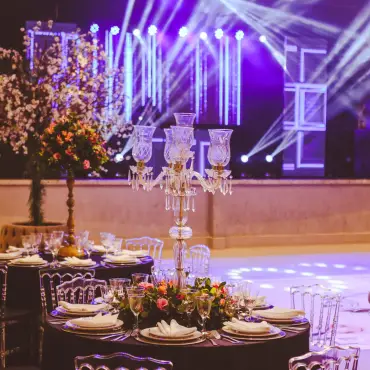
Table Decorations
Brass lanterns, crescent motifs, floral arrangements in decorative vases. Dates and fruit, placed on tables, symbolise sweetness and abundance.
Lighting and Draping
Lanterns, chandeliers, string lights, layered for atmosphere. Chiffon, silk draping, softening stages and entrances.
Popular Colour Themes
Gold, white, ivory, classic and refined. Emerald, ruby, sapphire, rich and opulent. Blush, pastel, gentler and contemporary.
What Should Guests Know Before Attending a Muslim Wedding?

Dress Code and Modesty
- Shoulders, knees and necklines are typically kept covered for both men and women.
- A headscarf isn’t usually required for non-Muslim women, unless the ceremony takes place inside a mosque.
Gender Arrangements
- Some weddings separate men and women, especially during the Nikah, while others keep celebrations mixed throughout.
- Following the lead of the hosts is the safest approach rather than assuming either setup.
Cultural Etiquette
- Arriving on time for the ceremony matters more than for the reception.
- Physical affection between guests is best kept low-key, and alcohol is almost never served or expected.
Gift-Giving Etiquette
- Cash in an envelope remains the most common gift, though small jewellery or household items suit closer relationships.
- Matching the amount typical within the local community is generally safer than guessing independently.
Respecting Religious Practices
- Guests aren’t expected to join prayer breaks but should stay quiet while others step away.
- Photography during the Nikah calls for restraint, as some families prefer that moment to remain undocumented.
What Are Some Common Misconceptions About Muslim Weddings?
- Not every ritual carries religious weight; only the Nikah, consent and Mahr are religiously required.
- Clothing, feasting and decor customs come from local culture rather than Islamic law.
- Arranged marriages are often mistaken for forced marriages.
- Islam requires the explicit, willing consent of both bride and groom for a valid marriage.
- Muslim weddings vary widely across Arab, South Asian, Turkish and Southeast Asian communities.
- No single style or ritual defines a “typical” Muslim wedding.
How Can Professional Event Styling Enhance a Muslim Wedding?
Customised Stage Décor
- Nikah and Walima stages are designed around the couple’s chosen theme.
- Arches, drapery and detailing are tailored rather than generic.
- Layouts adapted to suit venue size and guest flow.
Floral Arrangements and Backdrops
- Arches, flower walls and centrepieces balanced for elegance over excess.
- Blooms are selected to stay fresh through long celebrations.
- Backdrops coordinated with the overall colour palette and theme.
Elegant Table Settings
- Linens, centrepieces and place settings styled cohesively.
- Details echoed across the wedding banquet for a unified look.
- Setups elevated beyond standard rental packages.
Lighting and Ambience
- Warm tones and uplighting used to shape the mood across the venue.
- Accent lighting highlighting the stage, entrance and dining areas.
- Layered lighting plans create depth rather than flat illumination.
Conclusion
A Muslim wedding brings together faith, family and culture in a way few celebrations manage, weaving religious meaning into every layer of festivity without letting either element overshadow the other. Shaped by Arab tradition, South Asian custom or Southeast Asian ritual, each wedding tells a story rooted in shared values of consent, respect and communal joy.
Bringing that story to life takes more than good intentions; it takes thoughtful styling that honours both the significance of the occasion and the personality of the couple. Classy Event Suppliers, being the best event hire company in Sydney works closely with families to design stages, florals, table settings and lighting that reflect exactly this balance, helping every celebration feel as meaningful as it looks. Contact us to start planning a wedding that truly does justice to your traditions.
Frequently Asked Questions
How long does a Muslim wedding ceremony last?
The Nikah itself often takes fifteen to thirty minutes, though surrounding celebrations can stretch across several days.
What is the difference between Nikah and Walima?
The Nikah is the Islamic marriage contract, while the Walima is the wedding banquet hosted afterwards to celebrate the union.
Is the Mehndi ceremony part of every Muslim wedding?
No, it’s a cultural custom rather than a religious one, common in South Asian and Middle Eastern communities but not universal.
What should guests wear to a Muslim wedding?
Modest clothing covering shoulders, knees and necklines, with festive colours welcome.
Do Muslim wedding traditions vary by country?
Yes, the Nikah stays consistent, but customs around attire, food and rituals differ across Arab, South Asian, Turkish and Southeast Asian communities.



Add Comment